Showing posts with label Medicaid expansion. Show all posts

Wednesday, February 25, 2015

Gallup: More in NC insured, but gains are small

North Carolina went from having just over 20 percent of its citizens uninsured in 2013 to 16 percent last year,  once the Affordable Care Act started offering subsidies to help people afford premiums, Gallup reported Tuesday.

But states that accepted federal money to expand Medicaid for the poorest adults saw bigger gains in coverage, according to the latest report from the Gallup-Healthways Well-Being Index,  which polls a random sampling of adults across the country. The national uninsured rate went from 17.3 percent to 13.8 percent, the lowest in the seven years of the well-being poll.

"Collectively, the uninsured rate in states that have chosen to expand Medicaid and set up their own state exchanges or partnerships in the health insurance marketplace declined significantly more last year than the rate in states that did not take these steps," Gallup reports. "The uninsured rate declined 4.8 points in the 21 states that implemented both of these measures, compared with a 2.7-point drop across the 29 states that have implemented only one or neither of these actions."
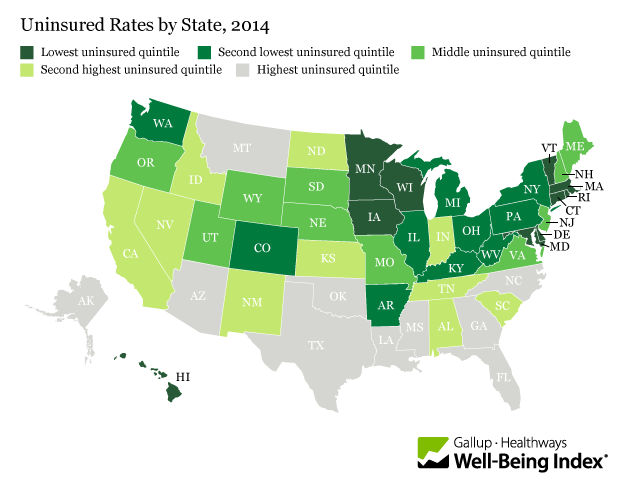

North and South Carolina, along with many Republican-led states, neither set up an insurance exchange nor expanded Medicaid. 

As Rose Hoban with N.C. Health News recently reported, bankers and business leaders have been receptive to the argument that expansion would bring financial benefits to the state,  though the state Chamber of Commerce has taken no position. And a coalition of health and anti-poverty advocates argue that expansion would save lives and create jobs. But state legislative leaders remain wary of the costs and complexities of expansion, and Gov. Pat McCrory has said he'll delay any plans to expand coverage until the U.S. Supreme Court rules on a challenge to the ACA.

Tuesday, February 17, 2015

Unanimous vote to expand N.C. Medicaid? Well ...

Jeff Jackson,  a Democratic state senator representing Mecklenburg's District 37,  knows how to have fun with a snow day.

This morning he posted on Facebook that "Due to inclement weather,  I appear to be the only non-security person in the General Assembly this morning.  I feel like I should hurry up and pass Medicaid expansion.  Anything else while I've got the place to myself?


His constituents  --  or at least his Facebook friends -- got a kick out of that,  with more than 100 comments and 500 likes by 9:30 a.m.  He got a long list of requests,  from raising teacher pay to banning puppy mills and legalizing marijuana.

Around 8:30 a.m.,  Jackson started tallying his accomplishments:

Just came back from the Senate chamber. All votes were unanimous.
Medicaid = expanded. Teachers = paid. Film = jobs. What's next?
This is going to be like "Night at the Museum" except at the end we'll have a stronger middle class.

Sen. Jeff Tarte, a Mecklenburg Republican, later posted that he and several GOP colleagues were there working as well.   "Classic example of Democrats 'misrepresenting the facts,' "  Tarte sniffed  before tipping his hand with an "LOL" and an invitation for Jackson to join him for dinner.

By that time the #JustOneLegislator winter fantasy had gone viral.  Mutual Facebook friend Laura Hehn had a suggestion  --  "Work together and make some positive changes!"  --  and even offered a couple of new hashtags: #JustTwoLegislators or #JustTheJeffs.

Tuesday, February 10, 2015

Health activist moves from Obama's home to Tar Heel state

One of the best-known health care activists from President Obama's home state has recently moved to North Carolina.

Jim Duffett,  longtime director of the Illinois Campaign for Better Health Care,  relocated to Chapel Hill in August,  drawn by milder winters and job opportunities for his wife,  an oncology nurse.  In Illinois he spent 30 years working for affordable care and patient rights,  eventually building a coalition of 300 groups representing health care,  faith,  labor and various communities.

Duffett

"One fond memory is having had the honor of working with Obama on health care reform in Illinois during Obama's years as a (state) senator,  and now,  'knowing he is the president and still knows you,'  "  Duffett said in an interview with The  (Champaign)  News-Gazette.

Duffett,  a proponent of a single-payer insurance system,  has connected with the NAACP-led Forward Together Moral Movement and is looking for work in advocacy here.  He says he's still getting up to speed on North Carolina's health care scene,  but sees some similarities with his old turf.  Both states have powerful political opposition to Medicaid expansion,  he said,  and Illinois'  2013 approval was hard-fought and narrowly won.  In North Carolina,  he says,  he hopes to build alliances with some of the hospital,  medical and business interests that united with more traditional anti-poverty groups in Illinois.  "There's definitely going to have to be a bit more base-building,"  he said,  though the Moral Monday protests  "are definitely galvanizing folks."


Sunday, February 8, 2015

Single white Southerners: ACA benefits may await

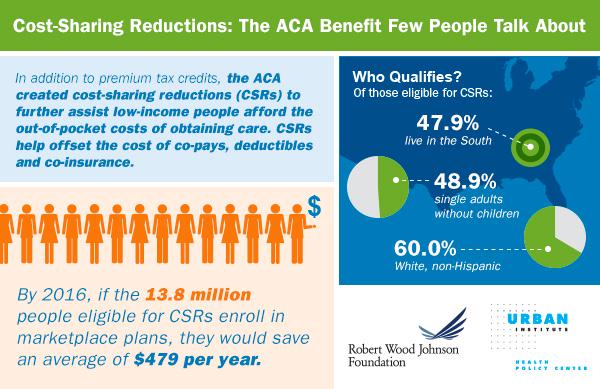
People who are eligible for aid paying out-of-pocket medical costs are most likely to be white, single and living in the South,  according to a new report from the Robert Wood Johnson Foundation and the Urban Institute.

Most people know that the Affordable Care Act provides tax credits  (aka subsidies)  to help low- and moderate-income people buy health insurance.  Less known,  the authors say,  is that people earning up to 200 percent of the federal poverty level  ($29,175 for a single person)  can also get help paying out-of-pocket expenses,  a major concern in an era of high-deductible policies.


"This benefit seems to fall off the radar sometimes,"  said Katherine Hempstead,  director of coverage for the Johnson foundation.  People need to choose a silver plan to qualify for that help, she added.  Those who choose a bronze plan for the lower premiums may end up worse off when they're hit with higher out-of-pocket bills.

The study looks at who is expected to fall into those income ranges in 2016,  though it's obviously timed to remind people about enrollment before the Feb. 15 deadline for 2015 sign-ups.  The authors broke the country into four regions and found that almost half of the eligible people live in the South  (a zone that includes such states as Texas,  Louisiana and Oklahoma,  as well the Southeast).

That's probably because many of those states,  including North and South Carolina,  haven't accepted federal money to expanded Medicaid.  In states that did,  people who fall below 138 percent of poverty qualify for Medicaid.  In non-expansion states,  those between 100 and 138 percent qualify for aid on the exchange.  Many who make less than the poverty level fall into the Medicaid gap and can't afford insurance.

Single people without children accounted for the biggest block by family status  (48.9 percent),  and non-Hispanic white people made up 60 percent of the eligible people.

The study doesn't account for how many people within the income brackets may have other types of  insurance and how many are already be getting the subsidies.

Friday, February 6, 2015

NC Medicaid battle: Hard numbers and human stories

The groups fighting for North Carolina to expand Medicaid this year are taking a two-pronged approach.

In news conferences in Charlotte and Raleigh this week,  the N.C. Medicaid Expansion Coalition urged people to share their stories at NCLeftMeOut.org.  They're looking for personal tales from people like Charlotte's Dana Wilson,  whose multiple sclerosis limits her to working a few hours a week at an antique shop.  Wilson doesn't earn enough to qualify for subsidized health insurance and isn't eligible for Medicaid.

Charlotte news conference

But the coalition,  led by Action NC and Progress NC,  is also taking a more hard-nosed approach, focusing on jobs and tax revenue that would be generated by accepting the federal money to expand Medicaid coverage.

A recent report by George Washington University's Milken Institute School of Public Health,  commissioned by the Cone Health Foundation and the Kate B. Reynolds Charitable Trust,  projects that if state lawmakers were to approve expansion this year,  the decision would generate about 43,000 jobs by 2020.  About half would be in health care,  the report says,  with the rest spread among sectors ranging from construction to retail "as health care workers use new income to pay their mortgages, buy groceries, pay taxes and so on."

"At county levels, if Medicaid is not expanded by 2016, Mecklenburg and Wake Counties would create about 4,500 fewer jobs each by 2020,"  the report says.  "Mecklenburg County’s total economy (gross county product) from 2016 to 2020 would be almost $1 billion lower."


"Lawmakers like to talk about fiscal responsibility,"  Wilson said in Charlotte Thursday.  "It's just common sense."


The Affordable Care Act includes money to expand Medicaid in all states  --  and levies taxes that everyone is paying,  regardless of whether the state accepts the money or not.  A handful of Republican-led states that initially said no have gotten permission to craft their own version of coverage.  Indiana was the most recent in late January,   and N.C. Gov. Pat McCrory has signaled some interest in crafting a North Carolina plan.

"As we review continue to review health care options for the uninsured,  we are exploring North Carolina-based options that will help those who can't help themselves, and encourage those who can,"  McCrory said in Wednesday's State of the State address.  "If we bring a proposal to cover the uninsured, it will protect North Carolina taxpayers. And any plan will require personal and financial responsibility from those who would be covered."


Read more here: http://www.charlotteobserver.com/2015/02/04/5494786/text-of-nc-gov-mccrorys-state.html#storylink=cpy
As the pro-expansion advocates noted,  that's still far from a specific plan.  And there's still little sign that Senate President Pro Tem Phil Berger or newly elected House Speaker Tim Moore are on board for any kind of expanded coverage.

Thursday, December 4, 2014

Congresswoman's first speech lauds Obamacare

Newly elected Congresswoman Alma Adams,  who took over the 12th district seat vacated by Mel Watt,  made her first speech on the House floor Wednesday and used it to praise the Affordable Care Act.

Adams
"Through the Affordable Care Act 208,000 individuals in my congressional district now have access to health insurance,"  Adams said,  referring to a mostly-urban zone that snakes through Charlotte,  Greensboro and Winston-Salem.  "The Affordable Care Act has also had a dramatic effect on unemployment,  creating 9.6 million private sector jobs.  My congressional district’s unemployment rate is 13.9 percent,  so for me this is not only about health,  but jobs and our economy."

Adams,  a Democrat from Greensboro,  was sworn in Nov. 12.  Most who won seats in the Nov. 4 election won't take office until Jan. 3,  but Adams is filling a gap left when Watt resigned early this year to become director of the Federal Housing Finance Agency.

The ACA,  often dubbed Obamacare,  is likely to be a hot topic as the GOP takes a majority of the U.S. Senate,  as well as the House.  Many Republicans,  including Senator-elect Thom Tillis of Mecklenburg County,  made opposition to the act a theme in their campaigns.

Adams got a jump on the debate:  "I urge my colleagues on the other side of the aisle to end talks of repeal and instead work with Democrats to strengthen the law to provide even greater access to health insurance."  She also called on state lawmakers to reconsider their  "purely political decision"  to reject Medicaid expansion.  The Kaiser Family Foundation estimates that 319,000 North Carolina adults who would have been covered by the expansion remain without access to government insurance or subsidies that would help them afford private policies. 

Tuesday, September 30, 2014

Asheville hospital: We're cutting ... and growing

Asheville's Mission Health,  which runs six hospitals,  has joined Carolinas HealthCare System in announcing job cuts as part of the 2015 budget.

Michael Tarwater,  CEO of the Charlotte-based system,  announced earlier this month that CHS is cutting 100 management jobs as part of its quest to trim $110 million.

Paulus
On Monday Ronald Paulus, CEO of Mission, said his organization had to find ways to offset $52 million in federal and state reimbursement cuts.  That included eliminating 130 full- and part-time  "caregiver positions,"  he said.  Fifty-five of those employees are leaving the system,  15 have found new jobs with Mission and 60 hope to do so, he said.

But the overall workforce will grow by 147 people, he added.  For instance,  he cited a primary care network of 275 physicians that didn't exist a year ago,  focused on  "safety outcomes and cost efficiency."  For Paulus'  eight-minute video message to employees,  click here.

Hospitals and medical practices across North Carolina are grappling with cuts to Medicare and Medicaid,  coming partly from the Affordable Care Act and partly from state efforts to reel in spiraling costs.  The state's decision not to accept federal money to expand Medicaid means North Carolinians are paying the costs for other states' expansion without getting the benefit of increased coverage for low-income adults.  Medicaid will be high on the General Assembly's agenda in January,  and some are watching to see whether our state will follow the lead of other GOP-led states that have found ways to put the federal money to use.


Friday, September 12, 2014

Oregon study: Does Medicaid matter?

"Medicaid doesn't make people healthier;  just look at the Oregon study."

I heard that comment a couple of times while I was reporting on Medicaid expansion,  from people supporting North Carolina's decision not to participate.

While I think that assessment is oversimplified,  I was intrigued to learn about Oregon's Medicaid lottery.  In 2008 the state randomly selected people to receive Medicaid coverage.  In the years that followed that provided a unique chance to study the role that coverage played in low-income people's health.

Image: Kaiser Health News
As you might expect, the results were complex and sometimes confusing.

Two years after the lottery,  people with Medicaid were more likely to have been diagnosed with diabetes and placed on medication.  But there was no significant improvement in their blood sugar levels,  which would have been a sign of ultimate success. There was also an increase in cholesterol monitoring,  but no significant differences in blood pressure or cholesterol between the Medicaid and non-Medicaid groups.

On the other hand, people with Medicaid were less likely to be diagnosed with depression and reported their own health as better.

On the financial front,  people who got Medicaid were less likely to have unpaid bills sent to a collection agency, "which also benefits health care providers since the vast majority of such debts are never paid," a National Bureau of Economic Research report notes.  But getting Medicaid also increased the rate of emergency room care for non-emergency ailments,  one of the least effective ways of getting treatment.

I don't think that justifies a conclusion that Medicaid does no good,  but the folks who raise that issue make an important point:  Just getting people covered isn't really the goal.  We want better health,  especially when we're spending billions of dollars.  And it's smart to take a close look at whether any reform brings the hoped-for results.

If you want to learn more about the Oregon experience,  here's a New England Journal of Medicine article and a 2013 Kaiser Health News/Washington Post interview with one of the Medicaid lottery winners.

"My blood pressure is still not perfect, but over the last two years I have stopped taking two different blood pressure medicines and am only taking half of a third,"  Mary Carson told interviewer Jordan Rau.  "That is a health improvement but it doesn't necessary show up in the study. My blood sugar is not perfect, but it's more consistently in the right zone. But according to the study, I haven't improved."

Wednesday, September 10, 2014

Southern parents most likely to lack insurance

Almost half the parents who lack health insurance live in Southern states, according to a new report from the Urban Institute's Health Monitoring Center.

The institute and Georgetown University's Health Policy Institute released two reports this week on how the Affordable Care Act has affected children and parents.

For children,  the answer is  "not much."  The act was designed to expand health-care access for adults;  most low-income children are already covered by Medicaid and the Children's Health Insurance Program,  known as CHIP.  The study on children found no significant change in insurance rates,  though researchers had hoped there might be a  "welcome mat effect,"  with publicity about the act helping impoverished parents who hadn't enrolled their children realize they're eligible for aid.


Parents saw the biggest increases in insurance coverage in the 28 states that have expanded Medicaid coverage for low-income adults.  There, the uninsured have gone from 15 percent of the population in the second quarter of 2013 to 10 percent in the second quarter of this year,  the report says.  In the states that didn't participate in Medicaid expansion,  the rate went from 21.5 percent to 19 percent.

Such large Southern states as North Carolina,  Florida and Georgia are among those that didn't expand,  which probably explains the disproportionate regional showing.  The South accounted for 49.9 percent of the nation's uninsured parents,  with the West at 30 percent,  Midwest at 12.6 percent and Northeast at 7.5 percent.  State data won't be available until next year,  the researchers said Tuesday.

Researchers grouped the two studies in the belief that expanding coverage for parents ultimately benefits children,  especially if it means parents get treatment for depression and other issues that detract from family well being.


Most uninsured parents described their health as good or excellent,  though almost one in three said they had at least two days of  "poor mental health" in the past 30 days.

Thursday, September 4, 2014

Debate brought no answers on health care

I suspect most Republicans,  Democrats and independents agree that America's health care system is far from perfect.  But last night's debate brought no insights from Democratic Sen.  Kay Hagan or Republican challenger Thom Tillis about how they'd improve it.


Instead,  each talked about how the other has made things worse.  Tillis,  speaker of the N.C. House,  talked about costs associated with the Affordable Care Act and repeatedly called Hagan a promise-breaker for saying people could keep their insurance policies under Obamacare.

Hagan blamed the cancellation of policies on insurance companies and said she pushed for an extension for existing policies.  She repeatedly said Tillis wants to  "take us back to a broken system,"  and blamed him for denying poor people coverage because of the General Assembly's decision not to expand Medicaid.  Asked to respond to that,  Tillis instead returned to his talking points about Hagan's broken promises.

There's been a lot of buzz lately about the role Obamacare will play in the upcoming Senate race.  Many have speculated that it's losing juice as a Republican attack point,  though Karl Rove seems to disagree.

At this point,  it's hard to tell how much emphasis the theme will get in Tillis'  advertising.  During the debate he mostly folded it into his  "rubber stamp for Barack Obama and Harry Reid"  theme,  while Hagan countered by portraying Tillis as  "giving tax cuts to the wealthy and paying for it by gutting education."

It might be a refreshing break to hear them both talk about practical ways to preserve what's good about the American medical system while putting better care within reach of more citizens.  But that doesn't make for good zingers.