Showing posts with label health insurance. Show all posts

Wednesday, February 25, 2015

Gallup: More in NC insured, but gains are small

North Carolina went from having just over 20 percent of its citizens uninsured in 2013 to 16 percent last year,  once the Affordable Care Act started offering subsidies to help people afford premiums, Gallup reported Tuesday.

But states that accepted federal money to expand Medicaid for the poorest adults saw bigger gains in coverage, according to the latest report from the Gallup-Healthways Well-Being Index,  which polls a random sampling of adults across the country. The national uninsured rate went from 17.3 percent to 13.8 percent, the lowest in the seven years of the well-being poll.

"Collectively, the uninsured rate in states that have chosen to expand Medicaid and set up their own state exchanges or partnerships in the health insurance marketplace declined significantly more last year than the rate in states that did not take these steps," Gallup reports. "The uninsured rate declined 4.8 points in the 21 states that implemented both of these measures, compared with a 2.7-point drop across the 29 states that have implemented only one or neither of these actions."
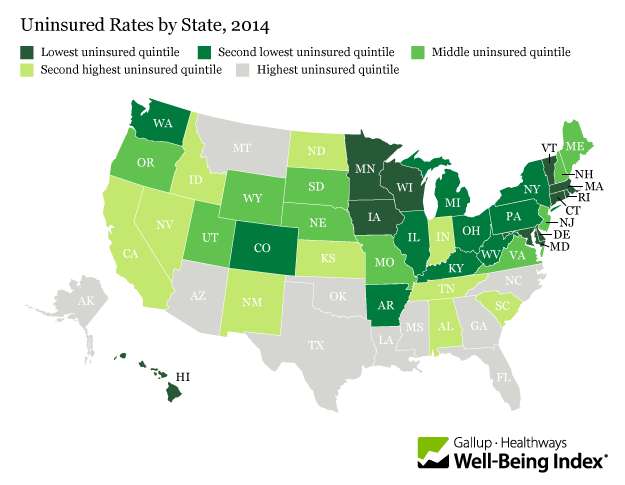

North and South Carolina, along with many Republican-led states, neither set up an insurance exchange nor expanded Medicaid. 

As Rose Hoban with N.C. Health News recently reported, bankers and business leaders have been receptive to the argument that expansion would bring financial benefits to the state,  though the state Chamber of Commerce has taken no position. And a coalition of health and anti-poverty advocates argue that expansion would save lives and create jobs. But state legislative leaders remain wary of the costs and complexities of expansion, and Gov. Pat McCrory has said he'll delay any plans to expand coverage until the U.S. Supreme Court rules on a challenge to the ACA.

Tuesday, February 17, 2015

Losing health benefits? Study blames recession

If your employer provides health insurance,  you're probably paying more for less  --  and wondering who's to blame.  The Affordable Care Act has contributed to rising costs by mandating certain types of coverage,  allowing many adult children to stay on parents'  policies and levying a 2018 tax on high-cost  "Cadillac plans."

But the trend toward reducing benefits and dropping health insurance altogether was in full swing before the act kicked in this year, according to a recent analysis by the University of Minnesota’s State Health Access Data Assistance Center and the Robert Wood Johnson Foundation.

Before to the recession, the research shows that employer coverage was fairly stable.  Between 2004-05 and 2008-09,  for instance,  North and South Carolina,  like most of the country,  saw no significant change in the percent of employers offering health insurance.  But the rates dropped from 2008-09,  the start of the recession,  to 2012-13.  In North Carolina it went from 53 percent to 47 percent,  and in South Carolina from 54 percent to 47 percent.  Most of that decline has come from companies with fewer than 50 employees.


That's consistent with what I've heard.  For instance,  I wrote last fall about Charlotte's Blue Max Materials,  a small employer,  dropping health insurance in the face of rising costs.  Meanwhile,  the owner of Stafford Cutting Dies bumped up deductibles dramatically to cope with skyrocketing costs for a small-business policy.


“Most Americans still get health insurance through their jobs, but this has been declining for more than a decade,” said Katherine Hempstead, who directs coverage issues at the foundation. “It will be interesting to see how that trend evolves now that there are more opportunities for coverage through the individual market and Medicaid.”

The report includes detailed breakdowns for each state.


Friday, February 13, 2015

So you got insurance. Will it help?

As the 2015 push for health-insurance enrollment winds down, the next challenge grows ever clearer:  Insured people who can't afford medical care.

The New York Times Sunday Review carried an article titled  "Insured, but Not Covered."  Reporter Elisabeth Rosenthal explores trends in insurance and health care that are leaving people with insurance unable to find doctors or pay bills.

Her conclusion:  While the Affordable Care Act has brought coverage to roughly 10 million Americans and eliminated  "some of the more egregious practices of the American health insurance system that left patients bankrupt or losing homes to pay bills,"  the law has also adopted policies that "may in some ways be undermining its signature promise:  health care that is accessible and affordable for all."

A key culprit is the boom in high-deductible policies,  which allow employers and private buyers to reduce premiums by agreeing to much higher out-of-pocket costs.


For instance,  HealthSherpa recently sent along an analysis of  14,000 North Carolina health insurance purchases made on the company's web site,  which provides an alternative path for buying subsidized plans on the ACA exchange.  Those buyers had an average household income of about $20,400 and bought policies that averaged $70 a month for the buyer,  with the government kicking in an average of $381 a month.

But the average deductible per enrollee was $3,969 and the average out-of-pocket max was $5,745.  Can you imagine anyone making less than $21,000 a year being able to save $4,000 to $6,000 to cover those costs?  Reality is,  even paying a couple of hundred dollars may be daunting enough to discourage people from going to the doctor's office.

A recent report from The Commonwealth Fund showed that the number of people skipping care because of costs declined in 2014,   the first time since the question was added to the fund's health insurance survey in 2003.  But while the numbers fell significantly compared with 2013,  the year before the ACA took effect,  the report estimates that 66 million Americans,  or 36 percent of adults, still skipped an office visit,  test,  treatment or prescription because they couldn't afford it.
ontinue reading the main storyBut by endorsing and expanding the complex new policies promoted by the health care industry, the law may in some ways be undermining its signature promise: health care that is accessible and affordable for all.

Friday, February 6, 2015

NC Medicaid battle: Hard numbers and human stories

The groups fighting for North Carolina to expand Medicaid this year are taking a two-pronged approach.

In news conferences in Charlotte and Raleigh this week,  the N.C. Medicaid Expansion Coalition urged people to share their stories at NCLeftMeOut.org.  They're looking for personal tales from people like Charlotte's Dana Wilson,  whose multiple sclerosis limits her to working a few hours a week at an antique shop.  Wilson doesn't earn enough to qualify for subsidized health insurance and isn't eligible for Medicaid.

Charlotte news conference

But the coalition,  led by Action NC and Progress NC,  is also taking a more hard-nosed approach, focusing on jobs and tax revenue that would be generated by accepting the federal money to expand Medicaid coverage.

A recent report by George Washington University's Milken Institute School of Public Health,  commissioned by the Cone Health Foundation and the Kate B. Reynolds Charitable Trust,  projects that if state lawmakers were to approve expansion this year,  the decision would generate about 43,000 jobs by 2020.  About half would be in health care,  the report says,  with the rest spread among sectors ranging from construction to retail "as health care workers use new income to pay their mortgages, buy groceries, pay taxes and so on."

"At county levels, if Medicaid is not expanded by 2016, Mecklenburg and Wake Counties would create about 4,500 fewer jobs each by 2020,"  the report says.  "Mecklenburg County’s total economy (gross county product) from 2016 to 2020 would be almost $1 billion lower."


"Lawmakers like to talk about fiscal responsibility,"  Wilson said in Charlotte Thursday.  "It's just common sense."


The Affordable Care Act includes money to expand Medicaid in all states  --  and levies taxes that everyone is paying,  regardless of whether the state accepts the money or not.  A handful of Republican-led states that initially said no have gotten permission to craft their own version of coverage.  Indiana was the most recent in late January,   and N.C. Gov. Pat McCrory has signaled some interest in crafting a North Carolina plan.

"As we review continue to review health care options for the uninsured,  we are exploring North Carolina-based options that will help those who can't help themselves, and encourage those who can,"  McCrory said in Wednesday's State of the State address.  "If we bring a proposal to cover the uninsured, it will protect North Carolina taxpayers. And any plan will require personal and financial responsibility from those who would be covered."


Read more here: http://www.charlotteobserver.com/2015/02/04/5494786/text-of-nc-gov-mccrorys-state.html#storylink=cpy
As the pro-expansion advocates noted,  that's still far from a specific plan.  And there's still little sign that Senate President Pro Tem Phil Berger or newly elected House Speaker Tim Moore are on board for any kind of expanded coverage.

Thursday, February 5, 2015

Separated, uninsured and out of luck?

A reader who's in the process of divorce emailed to ask whether there's any way he can get help paying for health insurance this year.

He works part time and says he'd spend half his take-home pay buying a private policy.  His wife makes a lot more,  and the reader says he was told that because they're not divorced,  his household income includes her pay,  which puts him out of range for tax credits on the Affordable Care Act exchange.

Image: wikihow.com
"I was just wondering if I’m screwed until I am officially divorced,"  he said.

I thought I knew the answer  (yes,  but you can apply once the divorce goes through),  but Madison Hardee of Legal Services of Southern Piedmont says it's not that simple.

"Marketplace eligibility for couples who are married but separated is complicated,"  she wrote.  "You are correct that the marketplace asks consumers for their current marital status. However,  at tax filing,  the IRS will consider the marital status on December 31st of the tax year.  For example,  if a consumer is currently married and then gets divorced in July 2015,  the IRS will consider that person unmarried for the entire 2015 tax year."

So if the reader,  who asked that I not share his name,  applies now,  he'll presumably be denied any financial aid based on the combined income.  And if he doesn't enroll in a plan before the Feb. 15 deadline,  he won't automatically be eligible for special enrollment based on the divorce.  But if he enrolls now,  he can go back to HealthCare.gov after the divorce,  report the change in income and select a new plan if he qualifies for subsidies,  Hardee said.

Hardee is a lawyer who has been trained in ACA enrollment,  so she added even more caveats based on special circumstances.

My takeaway:  Anyone like this reader,  who faces crucial decisions about paying for care,  needs to hustle to take advantage of 10 more days of free assistance.  Don't ask your neighbor or your aunt or even a reasonably well-informed reporter.  Sit down with an expert who can review your individual circumstances and talk you through options.

To get free help in North Carolina, call 855-733-3711 or visit www.getcoveredamerica.org/connector. In South Carolina, call 888-998-4646 or visit www.signupsc.com.  Don't dawdle;  I'm hearing that appointments are filling up.

You can also call an insurance broker.  Or do a walk-in at Get Covered Mecklenburg's last-minute enrollment event from 10 a.m. to 4 p.m. Feb. 14 at the Children and Family Services Center, 601 E. Fourth St.

Just don't kick yourself on Feb. 16 for procrastinating.

Read more here: http://www.charlotteobserver.com/2015/01/23/5466303/obamacare-enrollment-grows-in.html#.VNKaf2jF_GE#storylink=cpy


Wednesday, February 4, 2015

Can GOP reform Obamacare?

As the Republican-led Congress begins its 2015  "repeal the Affordable Care Act"  season,  this seems like a good time to loop back to Philip Klein's examination of GOP alternatives for health care.

Tuesday's vote on H.R. 596 is part of an ongoing political drama that has already featured more than 50 house votes to repeal the ACA.  But in "Overcoming Obamacare,"  conservative health writer Klein delves into three long-term conservative strategies to reshape a broken system.

Roy
Avik Roy of the Manhattan Institute,  a former adviser to the Mitt Romney presidential campaign,  is a leading voice in what Klein dubs the reform camp.  Roy's plan preserves some elements of the ACA,  including the insurance exchange and protections for people with pre-existing conditions.

"Roy's philosophical starting point on the health care issue differs from that of many conservatives in that he has argued in favor of universal coverage, calling it  'a morally worthy goal.'  His plan is also based on the assumption that repeal is unlikely,"  Klein writes.

Roy's reform plan outlines changes that can be made piece by piece,  such as eliminating many of the ACA taxes,  allowing insurers to charge higher rates for older customers and extending private-insurance exchanges to Medicaid and Medicare.  He touts it as a politically feasible strategy that would make insurance cheaper and more appealing for young people while costing taxpayers less than the ACA.

Klein predicts that it's more likely to alienate members of both parties,  with Democrats resisting the changes while Republicans  "would be expected to embrace the goal of universal coverage" and  "cede major ground to Obamacare on taxes,  spending and regulations."

Coming soon:  A look at the "replace"  and  "restart"  strategies.

Monday, January 26, 2015

Healthy, wealthy and worried

Even people with health insurance who call themselves financially secure worry that they can't cover their out-of-pocket costs if a medical emergency strikes, a new survey from eHealth shows.

Two-thirds of 1,000 insured adults polled by Wakefield Research described themselves as financially secure,  yet half of that group said they would struggle to meet their deductible in case of an expensive crisis. The trend was even more pronounced among adults ages 25 to 39,  who described themselves as wealthier,  healthier and more optimistic about their finances than older counterparts. But 69 percent of the young adults doubted they could afford their deductibles.  Confidence about out-of-pocket costs was highest among those 55 and older.


Out-of-pocket costs are rising as employers and people who buy their own insurance try to rein in premiums.  eHealth's price index shows what many others have reported:  People are trending toward plans with higher deductibles this year.

eHealth, an online insurance exchange,  launched its Coverage Satisfaction Index to track consumer opinions about coverage,  health and finances  (read an overview of the December poll here).  The sampling was designed to be representative of the nation,  though the South accounted for 37 percent of those polled  (compared with 20 to 22 percent for the other three zones).  About 35 percent reported income of  at least $75,000,  with the rest evenly divided between those in the $35,000 to $74,999 bracket and those earning less.

Some of the results:

*Eighty-six percent described themselves as at least somewhat satisfied with the value of their current health plan,  with 40 percent saying they are very satisfied.  The poll found no difference among those who bought their own coverage and those who got it from an employer,  but those with such government-funded plans as Medicare,  Medicaid and military insurance topped 90 percent satisfaction.

*One-third of men and 38 percent of women said they've skipped medical procedures,  such as exams and immunizations,  to save money.

*Opinions are split on the impact of the Affordable Care Act on their health benefits,  with 32 percent saying it's positive,  28 percent negative and 40 percent saying there's no effect.  Those under age 40 were most supportive of the ACA,  with 45 percent citing a positive impact.

*When asked to name their top three financial fears,  "an expensive medical emergency"  topped the list  --  though that may be no surprise,  coming after a long list of questions about the costs of care.  Asked whether they spent more time thinking about the cost of their health insurance or their cable package,  63 percent said insurance and 37 percent said cable.

Tuesday, November 18, 2014

Hidden costs: A personal postscript

I recently made my first venture into the world of consumer cost control in health care.

As a baby boomer,  I grew up trusting my doctors to tell me what was needed,  with insurance picking up the tab.  In recent years I've joined many of you in seeing my premiums and out-of-pocket costs rise;  my family is now on a very high-deductible plan.

When my husband got a screening colonoscopy early this year,  we grumbled about being stuck with a $708 bill for anesthesia and pathology ($1,370 before the insurance discount),  but we weren't shocked.  We were mostly grateful to get more than $2,200 covered for the rest of the procedure.

It wasn't until I did an article on hidden costs for procedures that are supposed to be fully covered that I realized we should have asked more questions.  Dr. Rig Patel,  president of the N.C. Society of Gastroenterologists,  offered details on how and why patients can end up with big bills for a cancer screening that's supposed to be covered by all policies.

So when I got my reminder email,  I was ready.  First I followed Patel's suggestion to ask the questions in advance,  rather than making an appointment and quizzing the doctor as the procedure is about to begin.

When I got a scheduling staffer,  I asked about sedation/anesthesia.  She said the gastroenterology practice had changed its approach since the last time my husband and I did this.  Then patients were given Demerol/Versed,  known as conscious sedation.  Now they're put under with propofol,  which our policy doesn't cover,  unless they specifically ask for the old form of sedation.

I also asked about timing.  I'd been told to expect a follow-up in five years.  She said the recommendation was  "four to five years,"  and the practice was giving me the opportunity to do it at four.

Yeah  ...  no thanks.  When I make an appointment next year I'll ask for Demerol/Versed,  which worked fine the first time.  My father,  a surgeon,  always emphasized the slim but serious risks of anesthesia.  Never be put under unless it's a medical necessity,  he told me.  So skipping the propofol seems like a wise medical approach,  as well as a money-saver.

Some would cite this as an illustration of the value of shifting costs to patients:  With more skin in the game,  we stop being  "passive consumers."  I was pleased that the staffer got back to me quickly and had good answers.  But I can't help wondering why it falls to those of us with no medical training to figure out what to ask.  Wouldn't it make sense for the gastronterologist's office to lay out the medical and financial implications of a new approach and give all patients an informed choice,  rather than waiting to see who speaks up?


Thursday, September 11, 2014

You won't believe latest on employer health benefits

The most shocking thing about the Kaiser Family Foundation's 2014 report on employer health benefits may be the lack of shocking data.

The foundation,  which has been tracking health benefits since 1999,  reports that 2014 continues a period of  "historic moderation" in premium increases,  in the words of CEO Drew Altman.  The average premium for family coverage rose 3 percent,  to $16,834 a year,  with employers covering about $12,000 and employees about $4,800.

Altman and Kaiser VP Gary Claxton,  the study's lead author,  said Wednesday they know that talking about moderation clashes with the experience of many employees,  who are seeing out-of-pocket costs rise while wages stagnate.  And it contradicts some people's expectation that the Affordable Care Act would send rates through the roof.

Altman
"If you say that to an average person,  they may look at you like you're out of your mind,"  Altman told reporters.

Deductibles  --  the amount people are required to pay out of pocket before coverage kicks in  --  have been climbing steadily for the last few years.  Sometimes high-deductible plans are accompanied by a pre-tax savings account with employer contributions,  but the biggest recent growth has been in  "plain old vanilla high-deductible plans,"  Altman said.

Thirty-four percent of employees in small firms  (fewer than 200 employees)  and 11 percent of employees in larger companies have deductibles of at least $2,000 for an individual,  the report found.  That's up from 20 percent and 4 percent,  respectively,  in 2010.  Sixty-one percent of employees in small firms and 32 percent of those in large ones must cover at least $1,000 for an individual.  (Some preventive services are covered before the deductible is met,  as required by the ACA.)


"You've got both the ACA and market forces reinforcing each other on the issue of deductibles,"  Altman said.

The report,  done in partnership with the American Hospital Association's Health Research & Educational Trust, is based on a survey of more than 2,000 employers,  done between January and May.  Almost 150 million people are covered by employer-sponsored insurance.

While the Affordable Care Act is forcing changes in costs and coverage,  it also follows years of soaring costs for insurance and health care.  From 1999 to 2004,  for instance,  premiums increased 72 percent while average earnings rose 17 percent.  In the most recent five-year stretch,  premiums rose 26 percent while wages rose 11 percent.  Thus changes that feel extreme for workers  --  especially those whose plans are changing  --  can look modest in the historic context.

Of course,  the ACA is just starting to kick in.  And the health care market is very much in flux,  as my colleague Karen Garloch reported from this week's Carolinas HealthCare System board meeting.  As employers gear up for 2015 insurance enrollment this fall,  I'm working on a look at's happening locally and what lies ahead.  If you're willing to talk about your experience with a high-deductible plan in your workplace,  please get in touch  (my phone number and email are at right, below the photo).

Friday, August 15, 2014

Putting insurance in plain English

Quick: What's the difference between a copay, coinsurance and cost sharing?

Even if you've had health insurance for years you may hesitate and stumble.  And the Affordable Care Act has brought thousands of newcomers into the confusing world of physician networks,  deductibles and premium payments.

Blue Cross and Blue Shield of North Carolina,  one of two companies offering subsidized policies in our state,  has just launched an  "Answer Spot"  on the company website to help the newly insured take advantage of their coverage.  Combined with a 20-page  "Welcome Aboard"  guide and upcoming open-house events for new customers,  it's part of a push to put health insurance in language people can use.


"It really gives you kind of the Cliff Notes version"  of a complex subject,  says marketing director Bruce Allen.

The guides provide tips on deciphering and paying bills,  lining up a primary care physician,  understanding insurance networks and figuring out the most effective way to deal with common complaints.

Clear language is always a help,  though it won't eliminate all the frustration of navigating the health care maze.  Across the country,  there are reports of people who rejoiced at getting low-cost insurance,  only to learn that the trade-off is a limited selection of doctors and/or significant medical costs that aren't covered.  Those of us with employer-sponsored plans have been feeling that pain for years.  One of the challenges ahead,  for policymakers,  researchers and journalists,  is teasing out the ways the Affordable Care Act helps or hurts a system that was already struggling with rising costs.

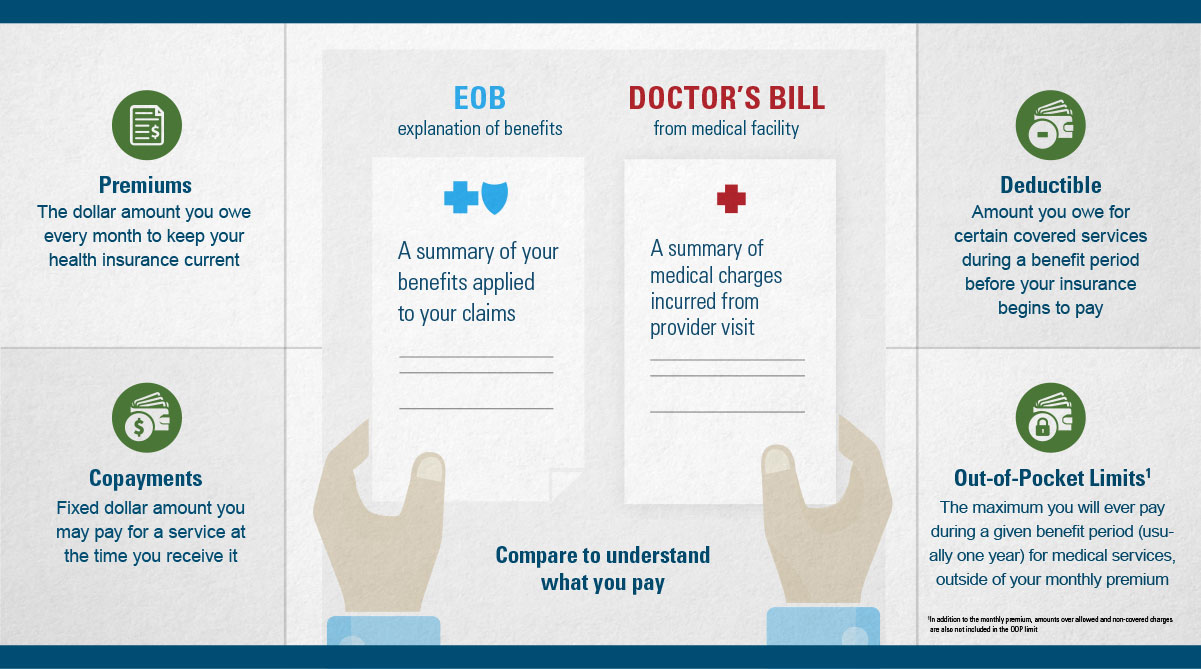
And if you're still puzzling over those definitions:  A copay is a fixed dollar amount the patient pays for doctor visits.  A deductible is an amount the patient has to pay for certain services before insurance payments kick in;  it can range from a few hundred to a few thousand dollars.  Once the deductible is met,  coinsurance is the percent the patient pays;  for instance,  insurance may cover 80 percent while the patient pays 20 percent.  Cost sharing encompasses all of those,  referring to the total out-of-pocket costs.

Friday, August 8, 2014

Obamacare and N.C.: A love-hate thing

Surveys and reports on health insurance and the Affordable Care Act highlight an interesting pattern:  North Carolina's elected leaders have done everything possible to avoid participating in "Obamacare,"  but significant numbers of residents are signing up for subsidized coverage.  As the News & Observer's John Murawski recently reported,  our state's 357,000 sign-ups during open enrollment ranked us fifth in the nation.

October sign-up in Charlotte
The seeming contradiction isn't limited to North Carolina.  Across the country there are signs that the act is meeting some of its goals,  with uninsured rates declining and insurance companies announcing plans to expand participation. Yet a recent health tracking poll from the Kaiser Family Foundation found unfavorable views of the Affordable Care Act rising in July, to 53 percent  (compared with 37 percent favorable).


The Brookings Institution recently offered an interesting hypothesis about political opposition and citizen participation:  Anti-Obamacare ads may  "backfire"  by increasing awareness and enrollment,  Brookings fellow Niam Yaraghi wrote in a July report.

Yaraghi
"The four states with the highest per capita spending on anti-ACA ads are Kentucky, Arkansas, Louisiana, and North Carolina,"  he wrote.  In fact,  the Kantar Media CMAG report he used as a starting point shows that the two markets with the highest spending on anti-Affordable Care Act ads are Charlotte ($967,429) and Raleigh ($707,997).  The states with high spending were those with competitive Senate races,  such as North Carolina's  Kay Hagan-Thom Tillis contest. 


"Although the volume of spending on anti-ACA ads is driven by the competitiveness of the Senate midterm elections and may be effective in reducing the votes for the targeted political figure, they may not necessarily reduce the popularity of the ACA,"  Yaraghi wrote.  "... In fact, after controlling for other state characteristics such as low per capita income population and average insurance premiums, I observe a positive association between the anti-ACA spending and ACA enrollment. This implies that anti-ACA ads may unintentionally increase the public awareness about the existence of a governmentally subsidized service and its benefits for the uninsured."