Showing posts with label Robert Wood Johnson Foundation. Show all posts

Tuesday, February 17, 2015

Losing health benefits? Study blames recession

If your employer provides health insurance,  you're probably paying more for less  --  and wondering who's to blame.  The Affordable Care Act has contributed to rising costs by mandating certain types of coverage,  allowing many adult children to stay on parents'  policies and levying a 2018 tax on high-cost  "Cadillac plans."

But the trend toward reducing benefits and dropping health insurance altogether was in full swing before the act kicked in this year, according to a recent analysis by the University of Minnesota’s State Health Access Data Assistance Center and the Robert Wood Johnson Foundation.

Before to the recession, the research shows that employer coverage was fairly stable.  Between 2004-05 and 2008-09,  for instance,  North and South Carolina,  like most of the country,  saw no significant change in the percent of employers offering health insurance.  But the rates dropped from 2008-09,  the start of the recession,  to 2012-13.  In North Carolina it went from 53 percent to 47 percent,  and in South Carolina from 54 percent to 47 percent.  Most of that decline has come from companies with fewer than 50 employees.


That's consistent with what I've heard.  For instance,  I wrote last fall about Charlotte's Blue Max Materials,  a small employer,  dropping health insurance in the face of rising costs.  Meanwhile,  the owner of Stafford Cutting Dies bumped up deductibles dramatically to cope with skyrocketing costs for a small-business policy.


“Most Americans still get health insurance through their jobs, but this has been declining for more than a decade,” said Katherine Hempstead, who directs coverage issues at the foundation. “It will be interesting to see how that trend evolves now that there are more opportunities for coverage through the individual market and Medicaid.”

The report includes detailed breakdowns for each state.


Sunday, February 8, 2015

Single white Southerners: ACA benefits may await

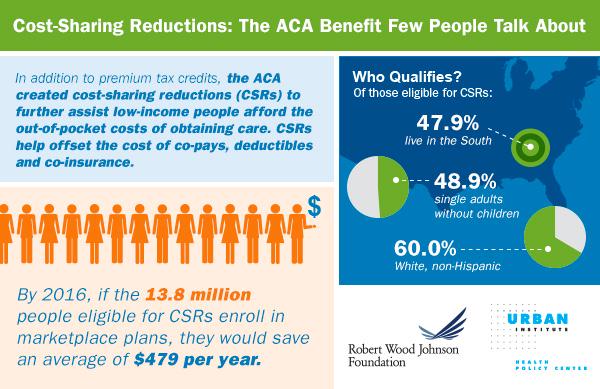
People who are eligible for aid paying out-of-pocket medical costs are most likely to be white, single and living in the South,  according to a new report from the Robert Wood Johnson Foundation and the Urban Institute.

Most people know that the Affordable Care Act provides tax credits  (aka subsidies)  to help low- and moderate-income people buy health insurance.  Less known,  the authors say,  is that people earning up to 200 percent of the federal poverty level  ($29,175 for a single person)  can also get help paying out-of-pocket expenses,  a major concern in an era of high-deductible policies.


"This benefit seems to fall off the radar sometimes,"  said Katherine Hempstead,  director of coverage for the Johnson foundation.  People need to choose a silver plan to qualify for that help, she added.  Those who choose a bronze plan for the lower premiums may end up worse off when they're hit with higher out-of-pocket bills.

The study looks at who is expected to fall into those income ranges in 2016,  though it's obviously timed to remind people about enrollment before the Feb. 15 deadline for 2015 sign-ups.  The authors broke the country into four regions and found that almost half of the eligible people live in the South  (a zone that includes such states as Texas,  Louisiana and Oklahoma,  as well the Southeast).

That's probably because many of those states,  including North and South Carolina,  haven't accepted federal money to expanded Medicaid.  In states that did,  people who fall below 138 percent of poverty qualify for Medicaid.  In non-expansion states,  those between 100 and 138 percent qualify for aid on the exchange.  Many who make less than the poverty level fall into the Medicaid gap and can't afford insurance.

Single people without children accounted for the biggest block by family status  (48.9 percent),  and non-Hispanic white people made up 60 percent of the eligible people.

The study doesn't account for how many people within the income brackets may have other types of  insurance and how many are already be getting the subsidies.

Monday, November 17, 2014

North Carolina's advantage: Easy access to personal help

Mary Gibson was frustrated.  I had run an article listing a number North Carolinians could call to get in-person help enrolling for health insurance, but what about South Carolina?  The HealthCare.gov link I had listed to look up local options provided little help.

My first try at finding a central contact for South Carolina had failed,  but I told her I'd keep looking and call her back.  I eventually found one  (888-998-4646)  by posting a query on the Facebook page of a friend who works for The Columbia State.  But the challenge illustrates a key finding of a recent study by the Robert Wood Johnson Foundation.

The foundation,  a New Jersey-based group that pushes for health care access,  set out to determine why North Carolina enrolled a significantly higher percent of its uninsured residents in the Affordable Care Act exchange than South Carolina did,  despite similar demographics and politics.  (The report also compares Wisconsin,  which also had relatively high enrollment,  with Ohio,  which did not.)

Get Covered Mecklenburg coalition hosted sign-ups Saturday
The conclusion:  North Carolina tapped longstanding partnerships between health care and consumer groups,  worked together to create a strong message promoting enrollment and created a central scheduling system that made it easy for people to get help signing up.

"The scheduling system tracked data on appointments,  sometimes enabling organizations to deploy additional Navigator support in areas with high demand,"  the report says. "...The establishment of a central toll-free number helped brand the Marketplace and create a unified message about where to go to obtain enrollment information."

The system wasn't perfect,  it continues,  but is serving as a national model for Enroll America,  a nonprofit group described as playing a central role in North Carolina's success.

"In contrast to the collaborative atmosphere in North Carolina,  there were notable conflicts in South Carolina,"  the report says.  "To the shock of many community-based organization,  the largest Navigator grant went to an out-of-state,  for-profit agency"  (DECO Recovery Management of Maryland).  As reports at the time indicated,  the results were fragmented and confusing.

This year the Charleston-based Palmetto Project scrambled to put together a statewide system for scheduling personal assistance after it got a federal grant in September.  I'll be curious to hear what upstate residents experience as enrollment begins.

The report also suggests that Blue Cross and Blue Shield's dominance of the North Carolina market may have proven an advantage in getting the word out.  Last year and again in 2015,  Blue Cross is the only company selling ACA marketplace policies statewide  (Coventry and UnitedHealthcare are competing in many counties).  The report suggests that dominance created an incentive for Blue Cross to market heavily statewide,  with such efforts as mobile units and events at retail outlets to reach the uninsured and newly insured.